
Debt Management, Default Dashboards, JPM Partnership
Overview
New features:
- Debt management: track loans, credit facilities, and interest alongside your cash
- Governed AI and app access: control exactly what AI agents and connected apps can do with your data
- J.P. Morgan connectivity: near real-time balances, transactions, and payments through J.P. Morgan's new API
- Default dashboards: every account ships with useful dashboards out of the box
- Forecasting models: five new models including Prophet, Auto ARIMA, and exponential smoothing, with per-model parameters
Improvements:
- Payment execution dates up to 180 days out
- New domestic payment schemes for Vietnam, the Philippines, and Serbia
- Higher forecast upload limit, up to 200 lines
- Stacked bar chart in forecast, view builder, and cash flows
- Switch organization from the navigation bar
- Filter search in the add-filter dropdown
- Date pickers respect your locale's date format
- Connection reports filterable by account
- Dedicated error states on every page
Debt management
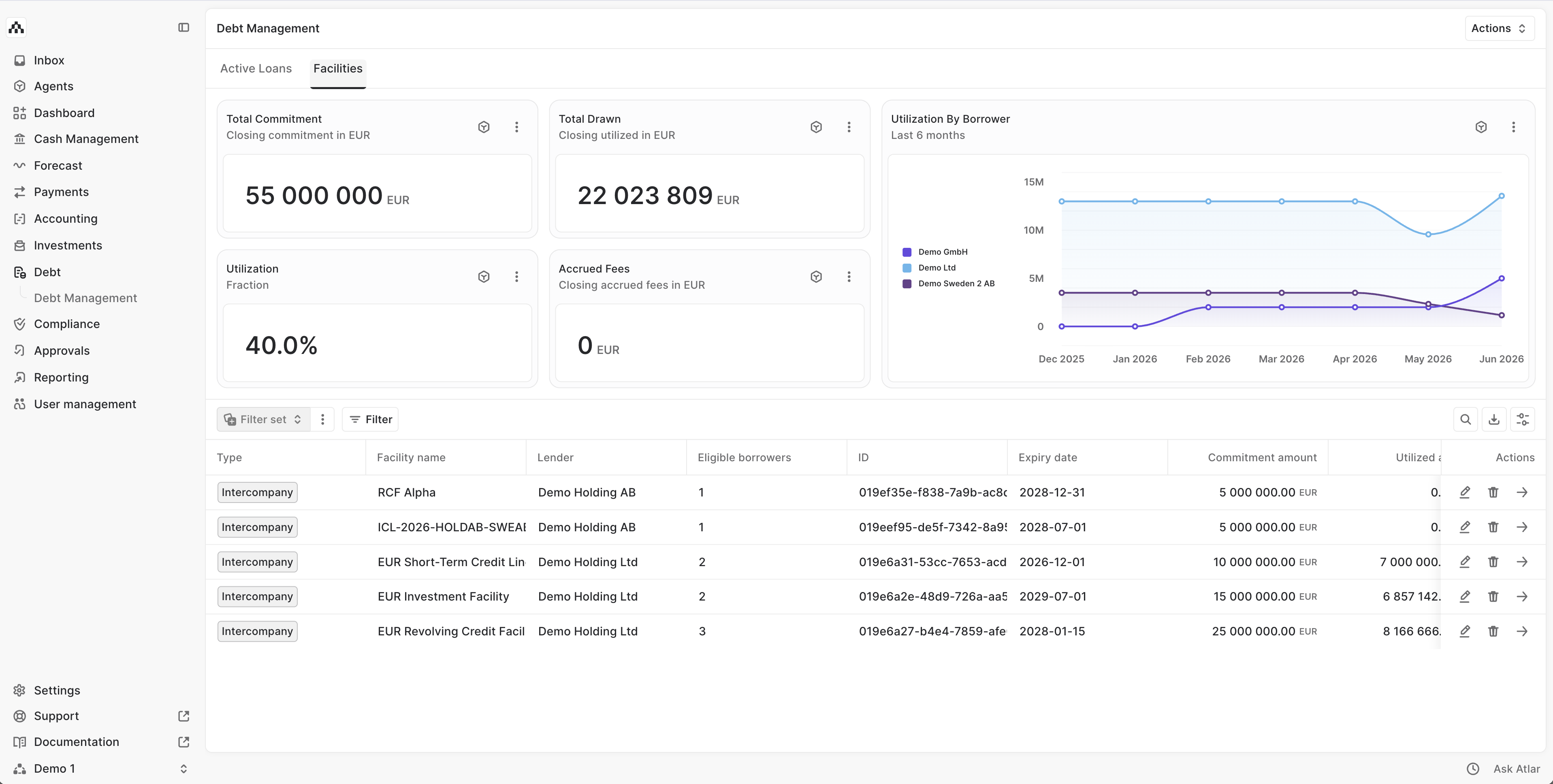
Track loans, credit facilities, and interest directly in Atlar. Your borrowing now sits next to your cash, payments, and forecasts instead of in a separate spreadsheet.
- Loans and facilities: Create loans and credit facilities, model drawdowns against a facility, and set eligible borrowers. Loan details show outstanding principal, accrued interest, amortization type, and key dates. Facility details show drawn amount, available capacity, accrued fees, and borrower list.
- Settlement schedules: Configure principal and interest settlement schedules per loan, including capitalization where interest is added back to the principal. Settled payments are logged automatically.
- Benchmark rates: Interest calculations reference live benchmark rates with the correct business-day calendars, so accruals land on the right dates. Set your margin, cap, and floor as percentages.
- Intercompany debt: Track loans between your own entities directly in Atlar.
- Default dashboards: Loans and facilities each come with a default overview dashboard.
- Edit and delete: Edit or delete loans, facilities, and activities directly from their detail pages.
Access is controlled by the new Debt module and dedicated read/write permissions, so admins decide who can see and manage debt.
Read more: Debt management
J.P. Morgan connectivity
Atlar is the first to connect through J.P. Morgan Payments' new API for treasury services and payments. Joint customers can authenticate and connect their J.P. Morgan accounts in seconds, with no IT work, and get near real-time balances, transactions, and payment data flowing into Atlar.
Read more: Atlar and J.P. Morgan Payments
Default dashboards
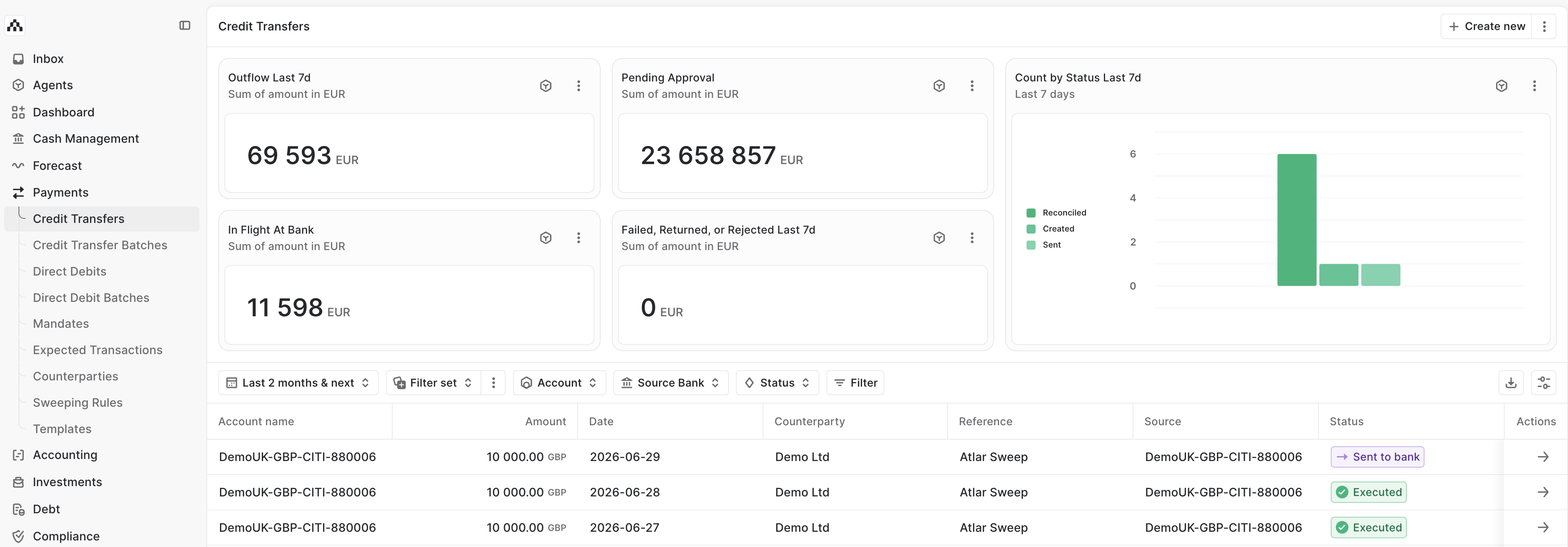
Every new Atlar account now comes with more dashboards out of the box. Credit transfers and direct debits each get a default dashboard built from the same widgets you can customize yourself.
- Metric widgets: New single-value metric widgets surface headline numbers at the top of a dashboard.
- Metric display in the view builder: Choose a metric output when building a view, alongside the existing chart and table types.
- Optional x-axis: Chart non-timeseries datasets without forcing a time axis.
Forecasting models
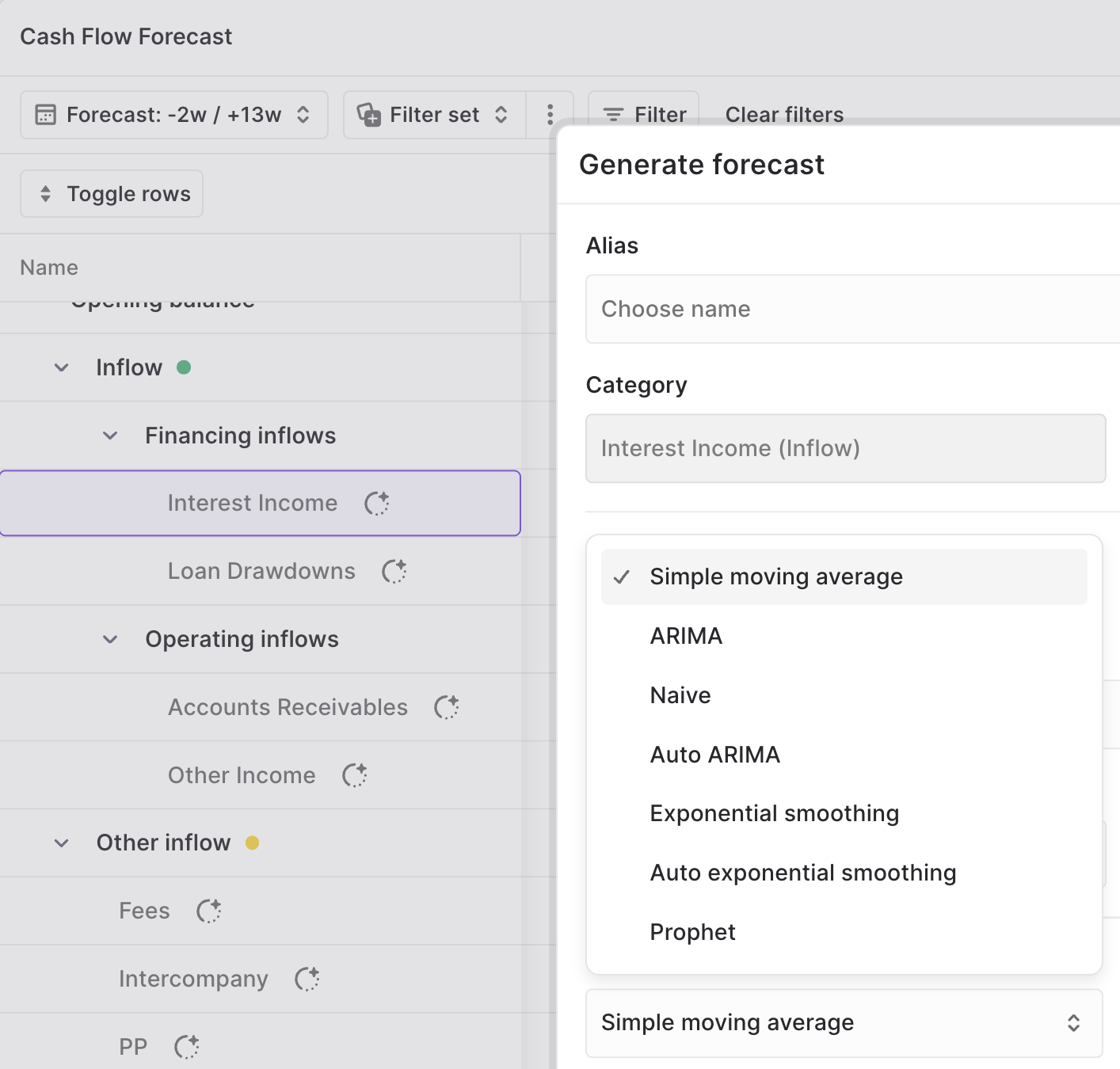
The model library has expanded from two models to seven, and every model now exposes its own tunable parameters.
- Prophet: Decomposes your cash flow series into trend, seasonality, and holiday components. Includes a seasonality mode parameter for series with strong recurring patterns.
- Auto ARIMA: Automatically searches for the best combination of trend, seasonality, and differencing parameters. Useful when you don't know the right ARIMA settings for a given series.
- Naive: Repeats recent values into the future. Without a seasonal period it carries the last value forward; with one, it repeats the last full cycle.
- Exponential smoothing: Forecasts using weighted averages where recent data counts more. Set trend and seasonality components manually for full control.
- Auto exponential smoothing: Automatically selects the best trend and seasonality combination from your historical data.
- Per-model parameters: Every model now exposes its own parameters in a collapsible section, so you can fine-tune without leaving the forecast form.
- Higher upload limit: Forecast uploads now accept up to 200 lines in a single import.
Additional improvements
- Longer payment horizon: Schedule payments with execution dates up to 180 days out.
- New payment schemes: Added domestic payment schemes for Vietnam, the Philippines, and Serbia.
- ACH initiator name: Set the initiator name on ACH payments.
- Stacked bar chart: A new chart type stacks inflows and outflows on opposite sides of the x-axis and shows net cash flow as a line. Available in forecast, view builder, and cash flows.
- Switch organization: Log out or switch organization directly from the navigation bar.
- Filter search: The add-filter dropdown now includes a search box for finding the right filter quickly.
- Date format: Date pickers honor your locale's date format, and you can jump months and years with dedicated selectors.
- Connection reports filter: Filter the connection reports tab by account.
- Investment tracking for everyone: Investment tracking is now available to all organizations.
- Resilient page loads: Each page shows a dedicated error state with a reload button if something fails to load, instead of a blank screen.
In progress
Several larger releases are in active development and rolling out to selected organizations:
- Accounting hub: Bank reconciliation with match confidence, document preview, GL classifications, and posting rules that bring accounting and bank data together in Atlar.
- Treasury Policy: Upload your treasury policy documents, have them parsed into individual rules, and monitor compliance so the AI Agent can check activity against your policies.
- Agent Skills and Workflows: Reusable instructions you can attach to AI conversations, plus scheduled multi-step agent workflows with templates covering liquidity stress testing, vendor payment optimization, FX exposure, month-end reporting, payment anomaly detection, and debt covenant monitoring.
- Forecast backtesting: Evaluate how your forecasting models would have performed against historical data, with metrics and charts per run.